
Chapter 2 of the IREn User Guide
Overview
This section contains introductory information about IREn.
2.1. Introduction
IREn is a library of Java classes that converts XML data to printable formats, such as PDF, PostScript, AFP, PPML. It can also produce SVG, XPS and XHTML files. IREn accepts either an XSL-FO file, or an XML file paired with an XSL stylesheet, as input. The XSL stylesheet can be specified via -xsl command line parameter or via xml-stylesheet processing instruction. In the case of XML with XSL input, IREn uses an internal XSLT transformer to preprocess the XML file according to the XSL stylesheet, thereby converting it to an XSL-FO file. The IREn engine then processes the XSL-FO file.
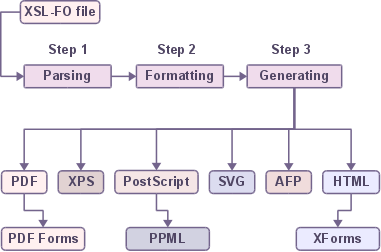
The logical flow of document processing can be divided into three phases, as illustrated in the following figure:
Figure 2.1. Three-step process
-
Parsing - IREn reads the XSL-FO file and creates an internal representation of the file in memory.
-
Formatting - The XSL-FO is fed into the formatter which creates and fills pages according to the specification defined in the XSL-FO document. Results of the formatting stage can be output as XML to be further processed later.
-
Generating - The XSL-FO file is converted to the requested output format - PDF, PostScript, AFP, SVG, XPS, XHTML or PPML.
IREn can be run in three different environments:
-
IREn Assistant - IREn includes a GUI-based tool for more comfortable transformation of files, suitable for users that prefer graphic interface. For a detailed description, refer to Chapter 3.
-
Command Line - IREn can be run from the command line as described in Chapter 4.
-
Integration - IREn can be integrated into other tools.
Figure 2.2. IREn
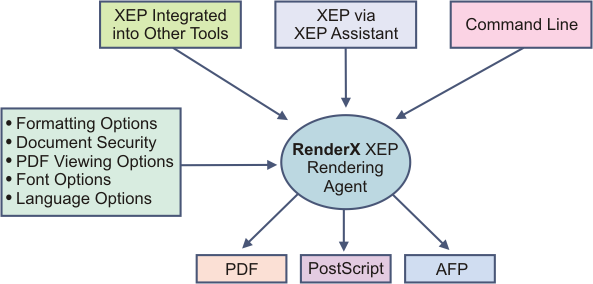
IREn can be configured to allow users to apply settings, such as fonts, languages and formatting options, according to their preferences. For a detailed reference please refer to Chapter 5.
2.2. Basic Terms
This section provides an introduction to the basic terms that are used throughout this documentation.
-
PDF (Portable Document Format) PDF is a universal file format that preserves the fonts, images, graphics, and layout of any source document, regardless of the application and platform that were used to create it. See the Adobe Web site http://www.adobe.com for more information.
-
PostScript® Adobe® PostScript® is the worldwide printing and imaging standard. Used by print service providers, publishers, corporations and government agencies around the globe, Adobe PostScript 3 gives you the power to print visually-rich documents. See the Adobe Web site http://www.adobe.com for more information.
-
AFP (Advanced Function Printing) AFP is an architecture standard for High Volume Transaction Output, supported by such vendors of printing equipment as IBM, Kodak and Xerox. AFP has built-in support for text and raster graphic output, vector graphic, vector and raster fonts, as well as many other features. The entire document structure of AFP document is organized by means of a higher level protocol called MO:DCA which links all printable objects together and builds the whole document.
-
PPML (Personalized Print Markup Language) The Personalized Print Markup Language (PPML) standard was introduced in May 2000 by PODi (see the PODi: the Digital Printing Initiative, website: http://www.podi.org). PPML is for high-volume and full-color variable data printing. Key concepts include the ability to leverage existing standards and to ensure interoperability between and among hardware and software vendors. PPML promotes the development of highly efficient print streams through object-level addressability and reusability for page components in a print workflow. PPML is an open industry standard that uses an XML grammar to define how to compose digital assets into objects, pages, documents, and sets.
-
SVG SVG is a language for describing two-dimensional graphics in XML. A World Wide Web Consortium specification. See the W3C website http://www.w3.org/TR/SVG/ for more information.
-
XPS The XML Paper Specification describes electronic paper in a way that can be read by hardware, read by software, and read by people. See the Microsoft website http://www.microsoft.com/whdc/xps/default.mspx for more information.
-
XHTML Extensible Hypertext Markup Language. XHTML is a markup language that has the same depth of expression as HTML, but also conforms to XML syntax. A World Wide Web Consortium specification. See the W3C website http://www.w3.org/TR/xhtml1/ for more information.
-
XForms XForms is an XML format for the specification of a data processing model for XML data and user interface(s) for the XML data, such as web forms. A World Wide Web Consortium specification. See the W3C website http://www.w3.org/TR/xforms11/ for more information.
-
XSL-FO XSL, Formatting objects. A standard way of specifying how content should be presented. A World Wide Web Consortium specification. See the W3C website http://www.w3.org/TR/xsl/ for more information.